AZEEZ ADEBAYO
0%
CONTEXT
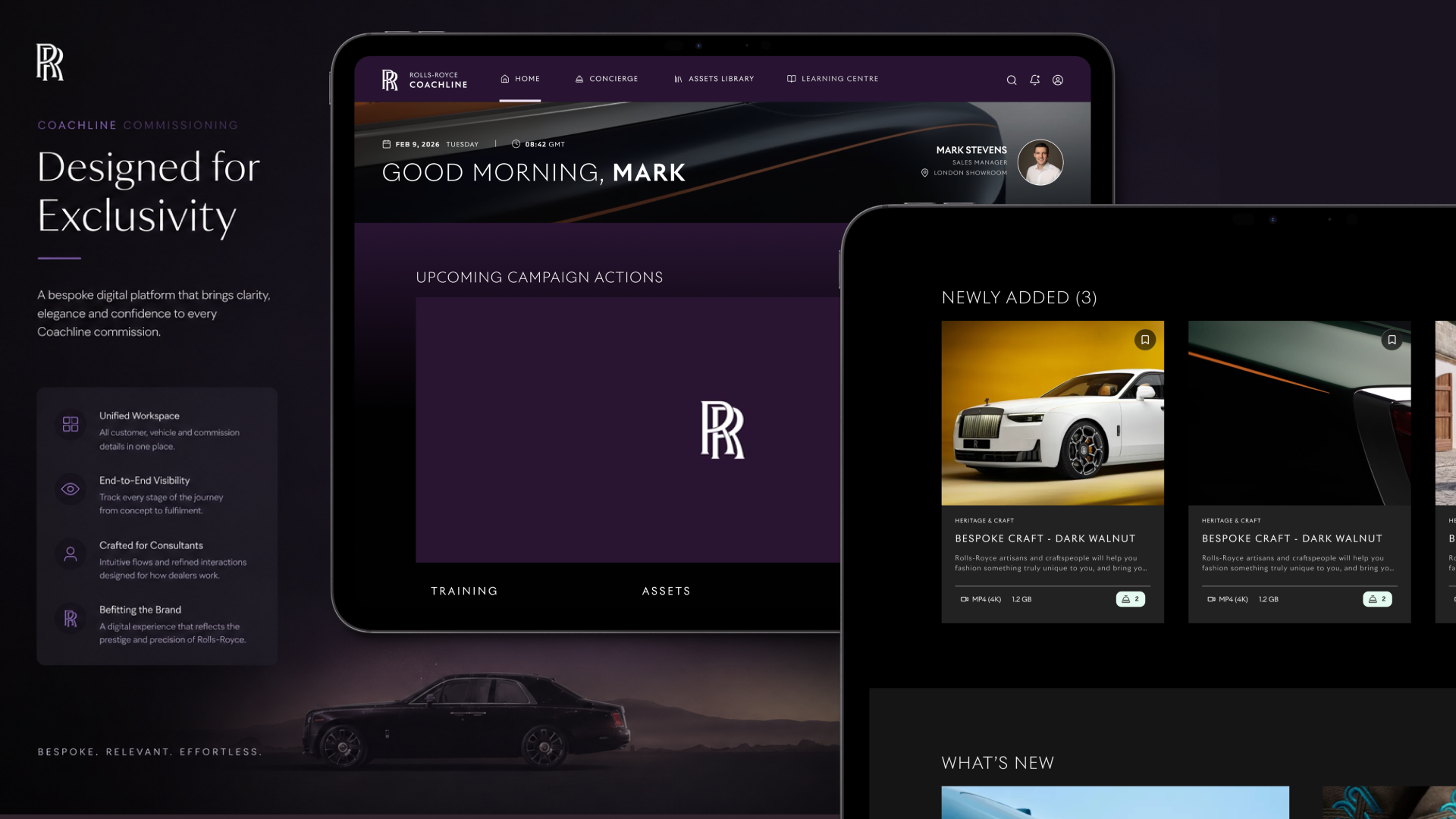
Rolls-Royce Coachline is the programme through which the brand's most discerning customers commission entirely personalised vehicles. Until this project, dealers managed that process manually — fragmented, error-prone, and entirely unworthy of the brand it represented. The brief was to build the digital infrastructure from scratch.
CHALLENGE
No existing system to replace. No legacy patterns to inherit. No access to the people who would use it.
Rolls-Royce's dealer network and its ultra-high-net-worth clientele aren't available for user testing. No analytics, no prior research, no comparable product in this space. Every design decision had to be earned through a different kind of rigour.
Rolls-Royce's dealer network and its ultra-high-net-worth clientele aren't available for user testing. No analytics, no prior research, no comparable product in this space. Every design decision had to be earned through a different kind of rigour.
GOAL
A dealer-facing web application giving sales consultants a single place to capture bespoke requirements, track specifications, manage exclusive requests, and plan fulfilment — efficient without stripping the process of its personal character and visually worthy of the Rolls-Royce standard.
APPROACH
(DESIGNING WITHOUT DATA)
With no user research available, the design compass had to come from elsewhere. We ran a structured benchmarking exercise across Bentley, Bugatti, private aviation, five-star hospitality, and high-end concierge services – looking for recurring principles in how the best luxury digital experiences handle restraint, information density, and the balance between efficiency and ceremony.
What we found consistently: luxury digital products earn trust through precision and calm, not ornamentation. Every element present must be there for a reason. Nothing competes for attention.
Those observations became our design principles — replacing user feedback as the evaluation filter for every screen and interaction.
What we found consistently: luxury digital products earn trust through precision and calm, not ornamentation. Every element present must be there for a reason. Nothing competes for attention.
Those observations became our design principles — replacing user feedback as the evaluation filter for every screen and interaction.
(TRANSLATING PHYSICAL LUXURY INTO DIGITAL)
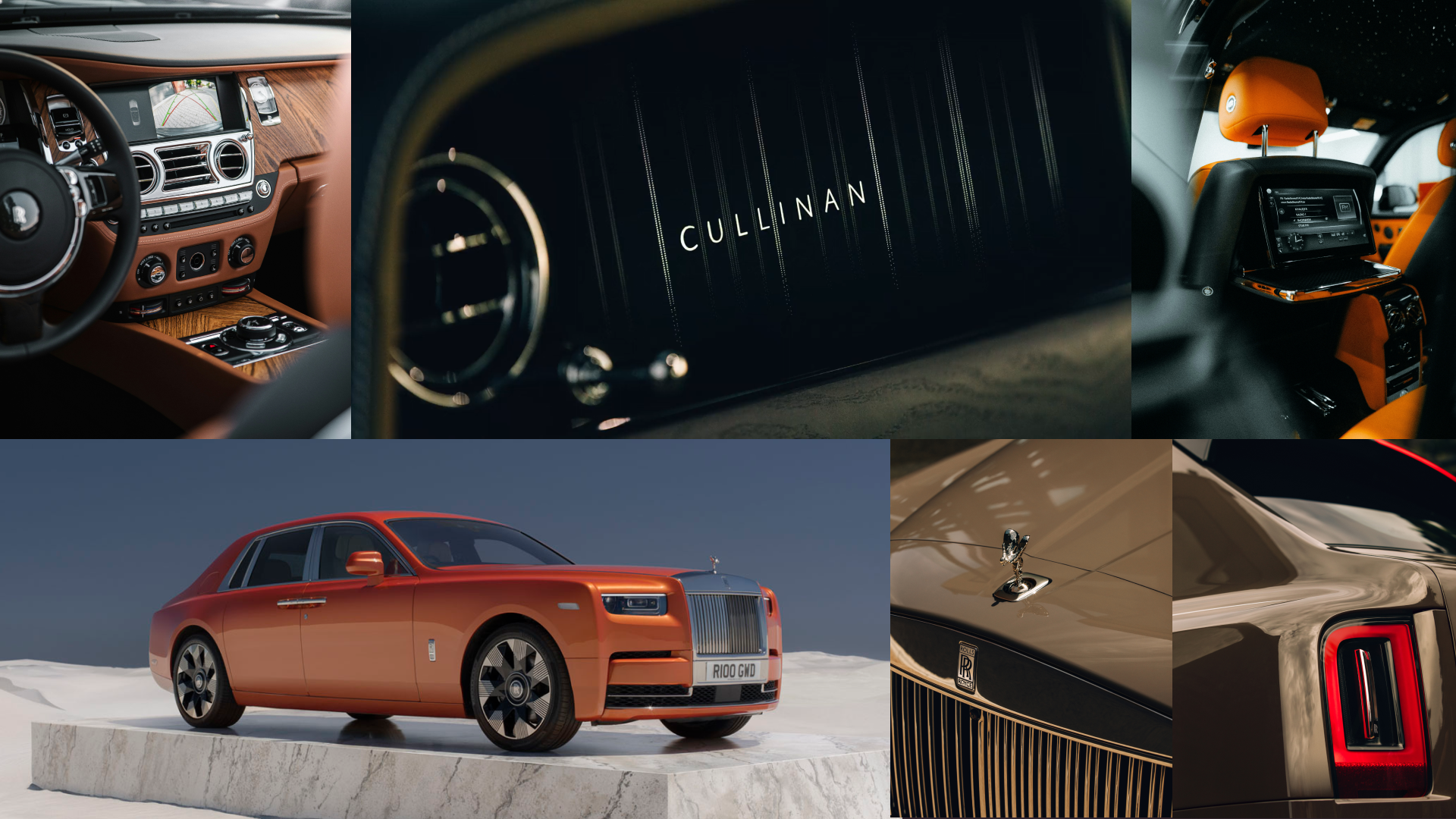
A Rolls-Royce dealership communicates exclusivity through every surface and gesture. The challenge was carrying that into a functional web application without stripping it of character or decorating it into illegibility.
We worked with deep neutrals, precise typographic hierarchy, and generous spatial rhythm. Interactions were designed to feel deliberate. Information architecture followed the dealer's natural workflow—capturing requirements, reviewing specifications, and managing fulfilment—in a sequence that mirrors a high-touch customer relationship.
The configurator required particular care. A Rolls-Royce customer's bespoke specification isn't a product selection — it's a personal commission. The interface had to handle that distinction.
We worked with deep neutrals, precise typographic hierarchy, and generous spatial rhythm. Interactions were designed to feel deliberate. Information architecture followed the dealer's natural workflow—capturing requirements, reviewing specifications, and managing fulfilment—in a sequence that mirrors a high-touch customer relationship.
The configurator required particular care. A Rolls-Royce customer's bespoke specification isn't a product selection — it's a personal commission. The interface had to handle that distinction.
LEADING THE WORK
I co-led visual and UI design alongside a peer, with UX handled by a separate workstream. Our job was to translate established UX flows into a visual language worthy of the brand — and hold that standard across five months and a net-new platform of significant complexity.
With no users to validate against, creative direction had to be unusually deliberate. Every visual decision was traceable back to one of three things: the benchmarking principles, the Rolls-Royce brand standards, or the functional requirements of the dealer workflow. Anything that couldn't be justified against one of those three was cut.
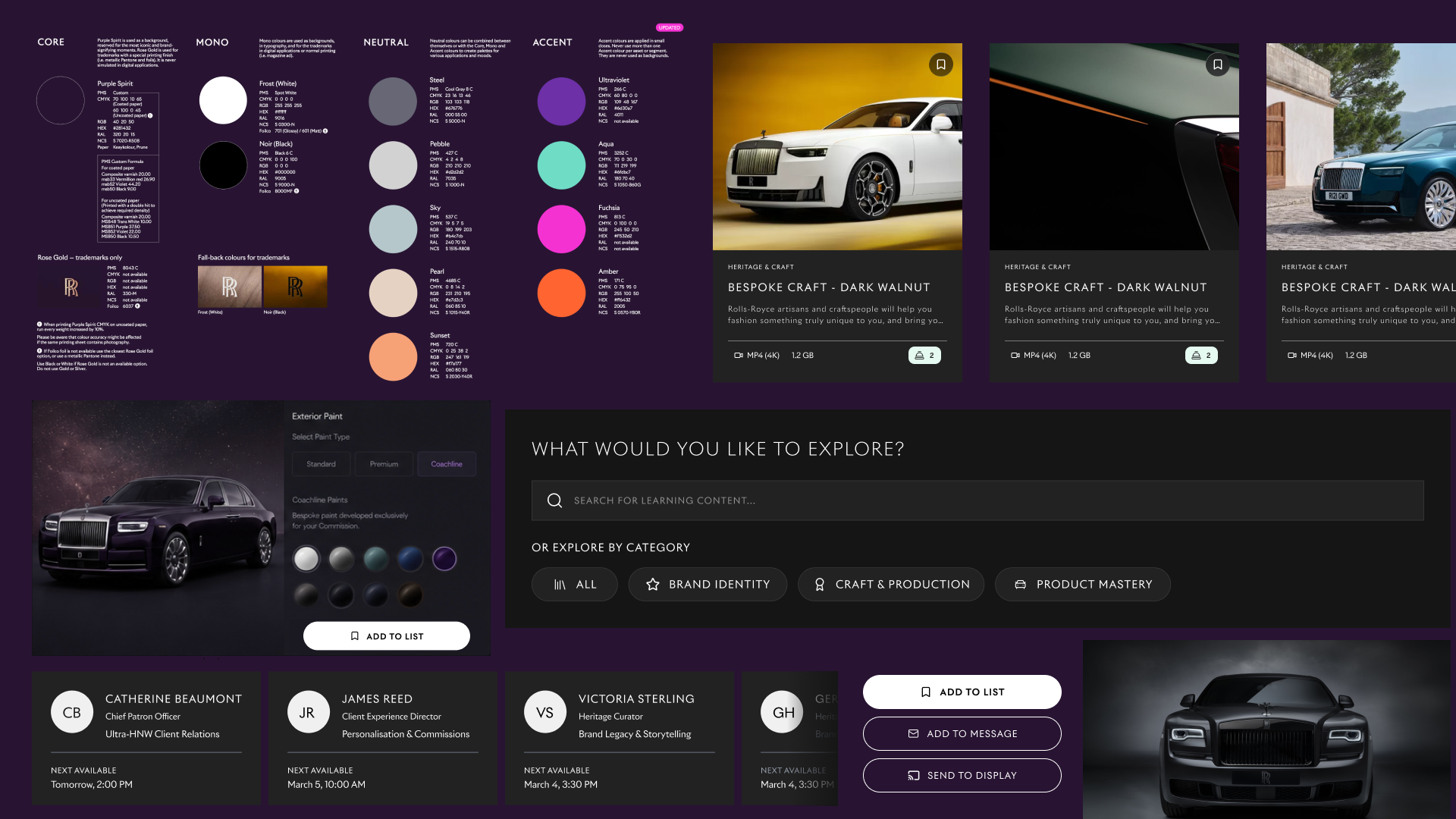
We established a component library by week two. On a tight timeline, that was the difference between maintaining velocity and relitigating the same decisions at every screen.
With no users to validate against, creative direction had to be unusually deliberate. Every visual decision was traceable back to one of three things: the benchmarking principles, the Rolls-Royce brand standards, or the functional requirements of the dealer workflow. Anything that couldn't be justified against one of those three was cut.
We established a component library by week two. On a tight timeline, that was the difference between maintaining velocity and relitigating the same decisions at every screen.
The platform
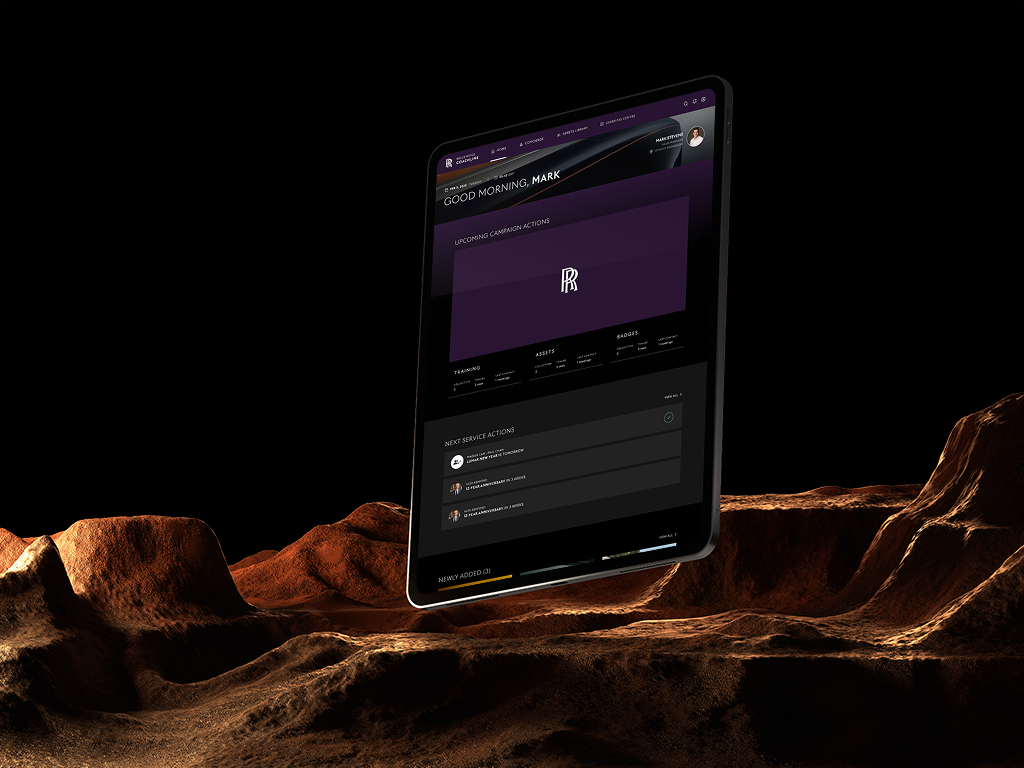
The Coachline web application gives dealers and sales consultants a unified view of each customer's bespoke journey, from initial requirement capture through tailoring specifications, exclusive request management, and fulfilment planning. For the first time, every element of a customer's commission lives in one place, visible to the right people at the right time.
The result is a platform that doesn't feel like enterprise software. It feels like an extension of the dealership, calm, precise, and entirely in service of the customer relationship it exists to support.
The result is a platform that doesn't feel like enterprise software. It feels like an extension of the dealership, calm, precise, and entirely in service of the customer relationship it exists to support.
Outcome
* Net-new platform delivered in five months — the first digital infrastructure Coachline had ever had
* Dealer feedback confirmed an intuitive experience that matches the Rolls-Royce brand standard
* Customer requirements, tailoring specifications, and exclusive requests consolidated into a single interface for the first time
* Benchmarking as a substitute for user research proved a replicable methodology for designing luxury digital products without direct user access
* Dealer feedback confirmed an intuitive experience that matches the Rolls-Royce brand standard
* Customer requirements, tailoring specifications, and exclusive requests consolidated into a single interface for the first time
* Benchmarking as a substitute for user research proved a replicable methodology for designing luxury digital products without direct user access
LET'S TALK
LONDON, UNITED KINGDOM